29 October, 2012

Closed for Hurricane Sandy, Updated

We're having a bit of weather here in Annapolis. Forecasts are for wind gusts as high as 70 mph and upward of 10 inches of rain today and tomorrow morning. I expect we'll lose power soon and it's doubtful that Fed EX or USPS will be picking up packages.

So I've asked the VO staff not to come to work today, and perhaps tomorrow. It might get dicey driving, never mind biking. Some of us will try to answer e-mails from home as long as we have power. We hope to get all orders out by late Wednesday if power and internet are restored. Sorry for the delay.

Update 10/30: The storm center passed well north of us and we are open and shipping orders again. Phones and e-mail are working.

24 October, 2012

Steel is... steel?

By Casey

Sometimes customers ask us what tubesets we use in our frames. Different tubesets can offer different benefits to the frame builder, but what difference does it make to you, the rider?

First, what isn't different between tubesets (intensive properties):
  • Elasticity of the steel
  • Weight by volume of the steel. (A cubic cm of high-end bike tubing steel weighs the same as a cubic cm of gas-pipe steel.)
Let's say you had two top tubes from two different tubing manufacturers. Assuming those top tubes have the same dimensions (length, diameter, thickness), then they would weigh the same and have the same rigidity.

So what is different between tubesets (intensive properties)?
  • Tensile Strength
  • Hardness
Tubes with a higher tensile strength can be made thinner; this in turn decreases their overall rigidity. It can also be tempting to think of this as meaning weight savings. Let's do a quick comparison of how much weight is saved within in the Tange line of tubing. Taking a top tube from the Infinity line and from the Prestige line, both are 590mm long and have an outer diameter of 28.6mm. The Tange Infinity tube has a thickness of 0.9mm on the ends and 0.6mm in the middle. The Tange Prestige tube has thickness of 0.7mm on the ends and 0.4mm in the middle. The Infinity weighs 287 grams, the Prestige weighs 207 grams. So you've saved a little less than a fifth of a pound in the top tube. You'll probably end up saving less than that between the down tube and the seat tube. That's not horribly insignificant but it is important to consider the trade off. 

One of my friends used to commute on a nice steel track bike. About a year ago he unlocked his bike from a bike rack. He left it leaning against the rack while he bent over to roll up his pant leg (should have had one of these). A substantial gust of wind blew his bike over and it hit the bike rack next to it dead center on the top tube, that 0.4mm thick section. This gave the top tube a nice dent, which eventually turned into a nice crack. The moral of the story (besides that track bikes might not be the best for commuting) is that different tubing sets offer different advantages. It can be tempting to look at them from an entirely monetary sense, but more expensive doesn't necessarily mean better.

Thin-wall tubing is very easy to dent. That's why we wouldn't recommend it for a commuting bike or a touring bike. It's also more likely to be destroyed in a crash, even a mild one. That high end thin-wall tubing may be okay for racing bikes, but you must still be careful with them.

At the end of the day, the best choice is usually to just trust your builder. They generally have specific tube sets that they prefer to work with and they will choose a tube set appropriate for your application (touring, track, racing, etc.). Sure, you may not be able to see everyone swoon when you tell them that your bike is made of 853 Reynolds, but your pockets might not feel as light, either.

By the way, VO uses a high quality 4130 double-butted tubing made in Taiwan (where a lot of "name brand" tubing is now also made). We feel that that the quality is equal to that of tubing from the old line companies, but by using this tubing we can knock $100 to $200 off our frame prices without losing ride quality or gaining weight.

19 October, 2012

New Grand Cru Canti Brakes

Sometimes I think that it would be nice to have the sort of company that makes the same unchanged few products for years or decades. But then I realize that we wouldn't be happy without continually tinkering with, and hopefully improving, our components. In this case it was the engineer who designs our brakes deciding they could be made better. So even though the MK2 brakes work and sell very well, we decided to introduce an updated and improved version.

The new MK3 version wide-profile brakes are significantly more powerful than previous versions. This is due to their longer arms. Longer arms increase mechanical advantage. But just as important is their excellent adjustability. They now have spring tension adjustment for easier centering.

We've kept the traditional wide-profile design of the MK2. And they still have slots for up and down adjustment of the brake pad. This means they fit perfectly on more frames and forks; not all canti studs are in exactly the same place due to manufacturing tolerances or intended specification. There is also an adjusting mechanism at the end of the straddle wire for easier setup and for fine tuning pad clearance and wire angle. (You'll wonder why all canti brakes don't have these adjusters.) Finally, the brake pads are fully adjustable for toe-in and angle.

The graph above shows the mechanical advantage of the three models of the Grand Cru Cantilever brakes at various yoke heights. It's good for comparison, but keep in mind that mechanical advantage also varies with different brake stud location, rim width, distance from pad to brake, exact arm position, and brake lever type. Also, you can't reasonably get the yoke below 100mm, so ignore the far left section of the graph. 

Should you order the MK2MK3, or Zeste brakes? Compared to the Zeste, the MK3 and MK2 are easier to set up because they are not as sensitive to yoke height variations. They are also more traditional, and perhaps cooler, in appearance. But they have a wide profile that can snag on panniers or heels if your bike has short chainstays. The Zeste brakes have more power and that may be important if you ride a loaded touring bike in the mountains, but they cost more. They also have a low profile. The MK2 brakes are still very good and a super value now that they're on sale.

16 October, 2012

Polyvalent Drawing by Ben Lively

Ben Lively creates amazing bike drawings. We're happy to offer signed prints of his Polyvalent Porteur drawing.

This is a digital drawing done with a Wacom pen tablet, a sort of electronic pen. It's printed on heavy paper and signed by the artist.The drawing's size is 18x24 inches. Its shipped in a mailing tube to prevent damage. The cost is $30.

A little about Ben, "I've been drawing since I was old enough to hold a pencil, and cycling nearly as long. Over time I began to combine my two favorite things and I've been drawing bicycles and components ever since. While I often draw everything from landscapes to comics, bicycles are still my favorite subject."

12 October, 2012

VO Complete Campeurs Available

Since I started VO I've wanted to offer a reasonably priced, but high quality complete bike--not just any bike, but one with really well designed and matched components. That's what made the French constructeur bikes great. Not only did the constructeurs make great frames, but just as importantly they were built in the shop with perfectly matching components and accessories. Many of those components and accessories were made, or at least designed, by the constructeur himself. The difference in the bikes I've wanted to offer is that they would be affordable to the average cyclist.

Before I go on, here is the complete build list. 
Not a bad build for $1600. But there are a few other, perhaps non-obvious, differences between our build and those from other moderately priced complete touring bikes.

First off, the Campeur assembled in our shop in Annapolis MD.

Next, the components are what we would ride. I'd have no qualms about hopping on this bike and riding a three thousand mile trip into the back of beyond. And I wouldn't say that about a lot of mid-priced off-the-shelf bikes. On some of them you might find a $6 bottom bracket with plastic cups hiding behind a nice looking crank. Or you might find no-name hubs or headsets with low-end bearings. Then there is the seat post without enough setback for a leather saddle. We've tried to address all these common problems.

The final point I wanted to make about these bikes is that they are an experiment and we'll make only a very limited number. The reason for this is that we really don't have the staff or space to build them in large numbers efficiently. But if they sell well, we'll lease another warehouse bay and hire more staff so we can do them in quantity.
Also, for those of you who prefer to do your own assembly we now have Campeur build kits.

10 October, 2012

Polyvalent Review Bike for Sale, 59cm

This MK1 Polyvalent was built by us to send to a publication for review. It got a good review (though it's not viewable on-line without a subscription), but the publication took some 11 months to return the bike. We've checked the bike over and it appears to have been ridden less than 100 miles. It's set up as a multi purpose bike for use as a commuter or tourer. The fenders were bent in return shipping and so are not included.

Highlights of the build include a Model 1 saddle, Polyvalent crank, 105 hubs, Pari-Moto tires etc. A full list follows. It's available for $1200.

  • Frame: 59cm Polyvalent MK1 frame & fork
  • Rear Wheel: Shimano 105 hub, Diagonale Rim, 650b, 36 hole
  • Front Wheel: Shimano 105 hub, Diagonale Rim, 650b, 32 hole
  • Tires: 650 x 38b  Pacenti Parimoto, virtually brand new
  • Shifters: Dia-Compe smooth bar-ends
  • Crankset: VO Polyvalent Double, 170mm, 46x30T 
  • Cassette: 8 speed
  • Rear Derailleur: Tiagra
  • Front Derailleur: FSA Compact Double
  • Headset: Grand Cru Sealed Bearing
  • Stem: VO Threadless Adaptor + 80mm threadless +/- 6 degree
  • Handlebar: Grand Cru Course 46cm
  • Brakes: Tektro CR720 Cantilevers, Grand Cru Constructeur Hangers
  • Brake Levers: Tektro RL340
  • Saddle: VO Model 1, Honey
  • Handlebar Tape: Tressostar Cotton, Brown
  • Pedals: VO Touring 
  • Bell: Brass Spring w/ headset spacer
  • Kickstand: VO Porteur


09 October, 2012

Price Drop on Frames and Other Interesting Things

This is the time of year that we go over our costs and pricing. As expected a few things have gone up. But the big news is that when analysed frame costs, including development costs, we found that we could lower them substantially. So we re-priced the Polyvalent and Campeur at an even $500. That's a $100 drop for the Campeur and a $50 drop for the Polyvalent.

By the way, those of you who bought a frame from the VO web store or in our showroom at full retail price in the past month will get a VO gift certificate in the amount of the price drop.

In other news:

Check out this paint job on a VO rando frame, from the very cool Ube's Icecream Shop blog.  The full post is here.
Box Dog Bikes of San Francisco, one of our oldest dealers, built this lovely townie based on a VO Rando frame. More here. Nice job Gabe!
A VO customer e-mailed to tell us about his Polyvalent. It's one of the original black Mk1s. He writes:
I noticed the recent blog post about your "other touring bike". I wanted to point out that you also have "that other rando bike". My Polyvalent MK1 has been a few different things since I got it, but it has developed well with my recent interest in Randonneuring. It still remains the most affordable 650b frame on the market, and it's a bonus that it fits fast 42mm Grand Bois Hetre tires with fenders. Maybe my favorite part is it's stable and consistent handling with even the largest Berthoud bag loaded on a front rack after a full day of riding. I've only done a Populaire and a recent Permanent course rid with Seattle International Randonneurs, my local club in Olympia Washington, but I don't plan to stop any time soon. I've lived in Olympia for a year and my Polyvalent has taken me to most ends of our city on local rides and commutes, so randonneurring is my next step in discovering more of the pacific north west on a busy work schedule. It seems that the Polyvalent has really filled a gap in the market, and truly lives up to its name for your customers.

05 October, 2012

Gravel

There are countless miles of gravel and dirt roads in America. Even here, on the east coast, you can find them once you get out of town. Of course they are great for touring, but Igor enjoys blasting down them. Here are a few photos of him putting a Campeur gravel racer through it's paces.
Here's Igor's build.
1940's style bottle cage mounting.
42mm tires

03 October, 2012

That Other Touring Bike

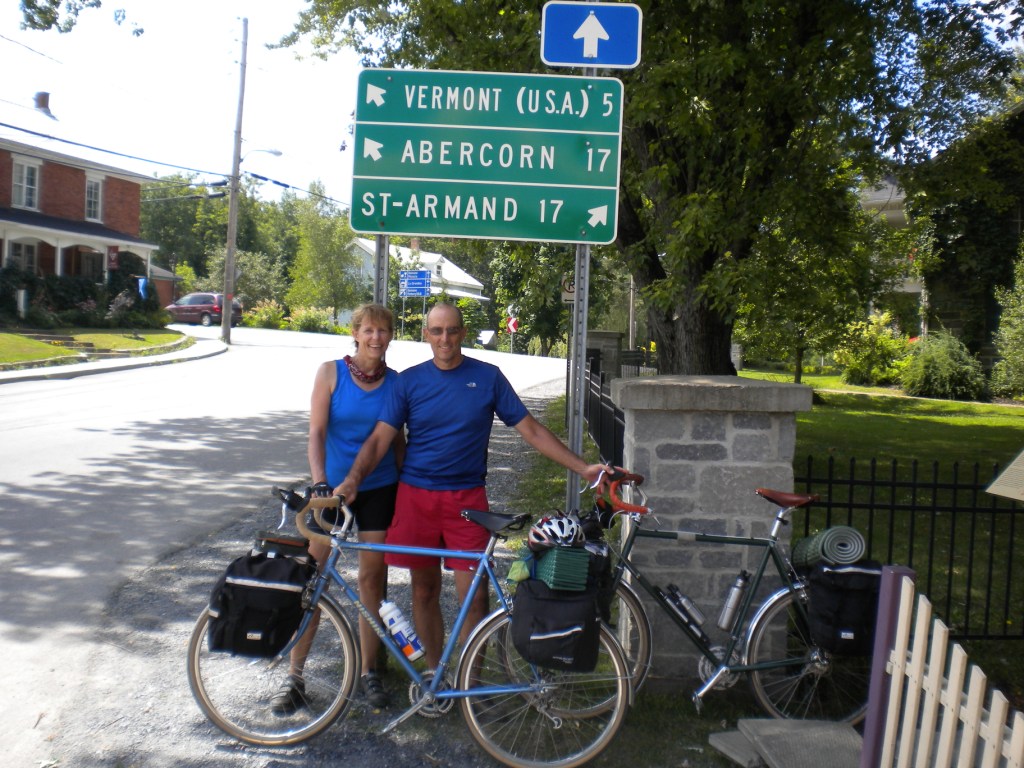
A local customer, Scott, wrote to remind us that we actually make two touring frames, In addition to the Campeur, there is the Polyvalent. Polyvalent means multi-purpose and that is exactly what we designed it to be. Scott recently completed a camping trip from Vermont to Montreal and back on his new Polyvalent. The entire e-mail follows.

I see there is lots of fuss on the VO blog over the arrival of the new Campeur frames, as well there should be, they look to be an excellent design, but let us not forget that the workhorse Polyvalent is also capable of doing a fine job at loaded touring as well. This summer I assembled a Polyvalent using many VO parts with my eye on making it an all-rounder - one equally adapt at commuting, loaded or unloaded touring, or using on club rides. So far it has met all my expectations quite easily, the only exception being that it was a bit slower on the club rides than my other bikes, no matter though as my desire to keep up with the hammer-heads get lesser all the time. As for it being a capable touring/camping rig, or a daily commuter, I couldn't be happier.

As a christening tour my friend Lydia and I set out on a week long, cross-border bike camping trip from Vermont to Montreal and back. Most of the riding was over flat terrain with about 30 to 40% of it on gravel bike paths or roads, and the rest of the time on pavement, including the very bike friendly city streets of Montreal. A more thorough test aver a hilly route is next on the list but one thing I am sure of is that for me, the 650b is the way to go on a touring or city bike. Over the years I've used 26", 27" and 700c bikes, with fat, medium and skinny tires but the Polyvalent with it's cushy riding Col-de-la-Vies really make me smile. It seems to be just the right combination of frame geometry and tire size that suits me. Currently the bike is getting a good workout as my daily commuter. Here are a couple of pictures towards the end of our trip;
The other bike is a rescued-from-Craigslist and repurposed Nishiki roadbike, eighties vintage, originally 27" but converted to 650b using VO wheels. This conversion is something to consider for anyone wanting a low budget, load capable bike, this one worked great for us and will be getting a lot more use after a few minor tweaks.

I saw the prototype Campeur at your warehouse just before it went into production and have no doubt it will earn a great reputation for its name, just like the Polyvalent has done.

01 October, 2012

Packing the Campeur Bikepacking Style, Part 2


A guest post by Nicholas Carmen (whose blog is Gypsy by Trade)

Here is a nearly complete packing list serves as an example of sensible lightweight kit, and doing more with less:

Camping and clothing:
  • Big Agnes Seedhouse SL2 tent
  • Mont-Bell 30deg down sleeping bag
  • Thermarest Pro-Lite 1” sleeping pad, full length
  • Gore-Tex Paclite waterproof shell
  • several t-shirts, thin wool socks (one warm pair for sleeping), underwear, nylon shorts, thin wool long underwear and wool long-sleeve shirt, zippered Capilene overshirt
  • Salomon Gore-Tex mid-height hiking shoes
  • assorted drybags for packing
As summer turns to fall:
  • Thin wool hat and rag wool gloves
  • Lightweight down jacket
  • Sil-nylon VBL inside sleeping bag
At the end of the season, and at elevation:
  • Packable rain pants and thin waterproof mitten shells
  • Merino wool neck gaiter
  • Gore-Tex gaiters in snow and mud to keep feet dry and warm

Tools:
  • Crank Brothers multi tool 
  • tire levers 
  • patches, tube 
  • needle and thread 
  • one brake cable (works as der. cable)
  • Presta valve adaptor
  • Lezyne Pressure Drive mini-pump
  • Pro-Link or T9 chain lube
On a longer trip:
  • 6” adjustable crescent wrench
  • cone wrench
  • diagonal cutters
  • spare spokes
  • spare bolts and nipples
  • Phil Wood bearing grease
  • Stan's sealant in tubes in SW states

Kitchen:
  • 0.8L aluminum cookpot, beer can stove, pot stand made from stainless steel spokes, windscreen from aluminum dryer vent
  • cheap steel spoon, Swiss Army knife
  • fuel (alcohol) in plastic drink bottle
  • enameled steel mug
  • 64 oz. Klean Kanteen, and several plastic bottles for water
Extended wilderness travel:
  • water filter

Personal items:

Maps, wallet, passport, small notebook, headlamp, toothbrush and paste

Electronics:

11” MacBook Air, Olympus E-PM1 digital camera, external hard drive, iPod touch, cell phone, chargers and cables

28 September, 2012

Packing the Campeur Bikepacking Style, Part 1

A guest post by Nicholas Carmen (who blogs as Gypsy by Trade)

The excitement to load my bicycle with expedition-grade racks and plastic waterproof panniers has waned, and is countered by a fascination with ride quality, rather than load capacity. My cycling interests have wandered off-pavement and over mountains, onto the Great Divide Route and the Colorado Trail, and a lessened load has become my best friend. A lightweight bike allows greater access to new terrain and reduces fatigue on both rider and bicycle. A smaller load equates to a lessened frontal face and an aerodynamic profile in headwinds or when riding fast. The bike is easier to lift over fences and rocky trails; best of all, it is fun to ride. With a quiet lightweight bike and larger volume tires, I can go anywhere.

On smooth flat terrain, a touring bicycle is at very little disadvantage to an unladen bike -- wheels are remarkably efficient. In mountainous terrain cycletourists grind uphill and coast downhill, spending much of their time ascending in extremely low gears, at slow speeds. There are no secrets to elevating a mass from the bottom of a hill to the top. Not even lower gears undermine the fact that work is the combination of force and distance, in which force is determined by the mass of the bike and rider, and the angle of the grade. Lower gears make many steep grades rideable, but a lighter load is the only real secret to scaling mountains and pedaling the land. It's just easier.

With less equipment the cycletourist climbs more nimbly, maintaining momentum and covering distances with ease. On unpaved surfaces, tire pressures can be optimized to quietly and comfortably float over obstacles and washboard. And on terrain that challenges the limits of rider and bicycle, having less stuff may be the only way through. Rough surfaces and high pressure tires are the cause of many physical discomforts, as well as broken rims, racks and spokes. I prefer a tire in excess of 40 mm for most of my riding, while a 45-50mm tire enables more rugged mountain roads.

An American Pass Hunter

I am excited that the new VO Campeur frames features generous tire clearances. Tires up to 42mm (45mm on the 59cm and 61cm sizes) allow for mild off-pavement riding on cyclepaths and most forest service roads, as well as for comfort and safety. The growing options for larger 700c tires include several from Schwalbe and Vee, the Clement X'Plor MSO, Panaracer Fire Cross, and the prevoyant Bruce Gordon Rock'n'Road. Many smaller cross-type tires are also suitable and will fit under a fender. Initially, I appreciated vintage 80's touring frames for all-purpose riding, but was drawn away due to limited tire clearances and inflated prices on the used market. The Campeur kills both birds. A Campeur with racks and panniers is well-suited to paved roads and graded rail-trails -- traditional touring fare. With a tidy, lightweight load and larger-volume 700c tires the Campeur is an American Pass Hunter capable of our scenic and remote roads as on the Great Divide Route. Strap a bedroll to the handlebars and attach a saddlebag. The Campeur turns from a capable gear-hauler to a dirt-road scorcher-- a real adventure bike!

Doing more with less


The secrets of a lightweight load are not in sawing off toothbrush handles or titanium sporks. Avoid redundancies and bring only what you need. While backpackers have known the benefits of lightweight travel for years, cycletourists have a tendency to “fill the truck”. Comfort, safety and preference will determine personal equipment needs, while packing for worst-case scenarios will ensure a heavy bike. Expect real conditions and plan for them; don't “what if” yourself into an extra pannier full of gear. Provisional items such as batteries, bandages, and the remaining six books in the series can be left at home and sourced along the way. Additional clothing, food and water are available in more places than you will require. The fact is, most cycling occurs along roads of some kind, and along roads are people and resources, and most often a willing pick-up truck in the event of a worst-case scenario.

When planning my adventures I pack relatively little clothing, rotating several t-shirts, socks and underwear with a single pair of nylon athletic shorts. Clothing quickly becomes laundry on the road, and touring the land with a bag full of smelly socks isn't particularly attractive. In the summer months I find it refreshing to swim multiple times daily, rinsing soiled clothing to maintain a reasonably clean exterior. I wear a single pair of reliable shoes for riding and walking. This is convenient when I require to push my bike up a steep, rocky grade. When the temperature drops, I expect to empty my bags wearing most of my layers, pairing a down jacket and thin wool long underwear with a 30-deg down sleeping bag. In the coldest weather, a vapor barrier liner allows me to comfortably sleep down to single digits inside my tent. If you are inclined to spend money on kit, replacing an older inexpensive tent and a too-warm sleeping bag will make the greatest reductions in packed size and weight. The remaining gear for a cycling trip is usually already in your closet, and only small reductions in weight and volume can be achieved with new equipment. Better to leave gear at home than to buy “lighter”. As such, lightweight cycling need not come at a great expense.

While my personal needs currently require a brick of electronics, one could easily pack 25 lbs. or less, including several day's sustenance. Regarding food and water, I typically prepare for the exact distance ahead, with a small reserve for unexpected delays. Considering the hundreds of dollars invested in lightweight equipment, one could easily negate the benefits of sil-nylon and tinanium with 20 lbs. of excess food and water. By consuming most of my food before resupplying, the average weight of packed food over time (full+empty/2) is minimized. Running low on food, but not starving, is a sign of good planning. Water is usually the single heaviest thing on a loaded bicycle: in wet climates I rarely fill more than one bottle, and I camp near water sources. A popular hiking tip is to “camel up” by drinking a liter of water at the source to avoid carrying it on the bike. Of course, water is quite precious in arid climates; it may be unavoidable to carry several liters, or more.

How to pack gear without a full load of panniers?

Reducing a load from four panniers to two is a good start. The effects of a lighter load are multiplied by the support equipment that becomes unnecessary, including racks and bags, stout wheels, and a “proper” touring frame. The Ortlieb panniers and Jandd racks I used on my first trip four years ago weigh over 12 lbs. and burdened me with extra clothing and food.

Rack-lite

Parting with panniers entirely, a “rack-lite” system may use an existing rack or a mini-rack. The VO Pass Hunter supports a handlebar bag, saddlebag or a drybag attached with straps, but it doesn't support panniers. Independent of weight, the benefits of riding without panniers are threefold: a quieter ride on rough roads, a narrower profile with greater ground clearance and aerodynamics; and distribution of mass near the center of the bicycle. Last year the Pass Hunter provided a strong lightweight saddlebag support mounted to the rear of my Schwinn High Sierra, cradling a Carradice Camper over many thousand miles of pavement and dirt roads.

Without a heavy load and the need for rack fittings, almost any bike can serve as a touring bike. With the ability to cover distances more easily, even fewer supplies are needed on-board-- it's a slippery slope to a really enjoyable, ridable bike.

Bikepacking

Further refinements exclude racks of any kind in favor of “soft” attachments. This mirrors the revolutionary philosophy birthed in lightweight internal frame backpacks in the 60's, the origins of the modern backpack. Framebags are made from durable “sailcloth” materials and provide efficient storage within the main triangle of the frame, relying upon the structure of the bicycle frame as the backpack relies upon the human skeleton. Modern accessory bags can be fit to the toptube, handlebars, or seatpost, while strapping a drybag to the underside of the saddle or handlebars is an inexpensive, lightweight approach to carrying gear. The growing availability of refined “bikepacking” style bags inspired by mountain bike touring and racing comprise one of the fastest growing trends in touring, and are almost exclusively handmade in the USA by local craftsmen. There's a lot to like about it, most importantly, the ride. This is how I would load my Campeur.

While lightweight travel is often considered the realm of endurance racers, randonneurs, and mountain biking “bikepackers”, the benefits of lightweight touring are for everyone. It need not be legitimized by epic distances and record times, or even an obsessive calculation of pounds and grams. Sometimes I ride fast and far, but I never hesitate to share with others that many of my days are spent swimming and drinking coffee, pushing my bike up rutted steep trails, or writing. The measure of success in my travel is fun and adventure. Lighten your load, throw a leg over the top tube and enjoy the ride.

26 September, 2012

VO at Interbike and Campeur Impressions


Gypsy by Trade published a great post about the Campeur, touring bikes, and various VO parts. Please read the whole article. Here's a sample:
Velo Orange released their new Campeur frame this past week at Interbike.  The features read like any touring bike– three bottle mounts, 46cm chain stays, cantilever brakes, rack and fender mounts everywhere– but the exterior is a cut above.  The Campeur accents its svelte stature and fine lines with metallic-flake grey paint, white decals, and a metal head badge.  A custom camping-themed design by cartoonist Dan Price adorns the top tube.  Chris Kulczycki, the owner of VO, reckons that after a year and a half of design, development and prototyping, they’ve gotten it just right.  For example, the curve of the fork blades required several efforts before the frame manufacturer was able to produce a consistent low-radius curve, as opposed to the common dog-leg style bends on many forks.  As well, the bike was tested with front loads and rear loads, as well as full loads and no loads to verify that the handling felt neutral in most cases.  While other VO frames are noted for their French classic low-trail geometry, the Campeur features a more moderate front end design, although it’s described as favoring the “low-trail” end of moderate.  Low-trail frames are ideal for front loads, although the Campeur is designed for multiple load configurations.

Bike Commuters has a new post entitled Interbike 2012: Velo Orange…sooo nice! Lots a photos.

The Path Less Pedaled as an interesting Interbike roundup here. Check out the Interview with Igor at minute-6 of the video.

Gravel Grinders is a very cool blog. You might like the Gravel Grinder News Interbike 2012 Report. The Campeur is near the end.

Guitar Ted liked the gravel racer build Campeur frame we displayed at Interbike. The full post is here.

Lovely Bicycle posted some lovely Interbike photos on Instagram as well as on the blog.

Then there is a small mention in All Hail The Black Market, a blog that's, well, hard to describe, .

Thanks to all the bloggers who mentioned us. By the way, we're happy to send products for review to those of you who have well known blogs with a solid following; just shoot us an e-mail.

25 September, 2012

Campeur Frames Are Here

The VO Campeur frames are finally here. It's taken a lot to make these, including almost a year of testing. We rode the campeur with front loads, with rear loads, with mixed loads, and with no load. We tried four different forks to get the best possible handling.

The Campeur, as the name suggests, is a touring bike for paved, or unpaved, roads. It can carry a substantial load for long unsupported trips, yet handles beautifully even with no load. In fact, it makes a nice gravel racer.

Here are some of the highlights and specs:
    • 4130 double butted chrome-molly frame and fork.
    • 1" fork with lovely French-style bend. Uses a traditional quill stem (or adapter and threadless-style stem).
    • 700c wheel size.
    • Clearance for 38mm tires with fenders. 
    • Canti brake bosses. Seatstay cable stop with adjuster.
    • Vertical dropouts with double eyelets front and rear.
    • Fender bosses under fork crown, at seat stay bridge, and at chain stay bridge for easy fender mounting.
    • Three water bottle cage mounts.
    • Lowrider through bosses and seat stay rack eyelets
    • Pump peg.
    • Kickstand plate, because touring bikes should stand up.
    • Metal head badge. Top tube decal by artist Dan Price.

18 September, 2012

Interbike Week


Most our technical staff left for the Interbike bike show yesterday. I'm flying out later today. That means that, for the rest of the week, there will be no tech support via telephone. If you have an urgent question please e-mail and we'll try to answer from Vegas, but there may be delays. The entire warehouse and shipping staff is still here so there will be no delay in getting orders out.


17 September, 2012

Gone Fishing

I thought I'd post a few photos we took recently for a VO brochure. We shot them at a nearby pond, so we got in a little fishing. I was reminded of these when I took my 13-year old son fishing on the upper Potomac yesterday. I'm not much of a fisherman, but he loves it, so I cast a few times and occasionally catch a bluegill or a little bass. Do any of our readers use a bike to go fishing?

That last photo is of my newly built up Campeur. Note the knob grips with guidennet levers, as was common on the old French campeurs. There's also a different style of mudflap that we might make, a reproduction of an old French shape.

14 September, 2012

The Big Pedal Named, "Sabot"

Thanks for all the great pedal names. We just had a staff meeting and chose "sabot", submitted by Everett. (Everett, please e-mail your last name and address.) A sabot is a bulky French wooden clog. If you wore sabots you would want these pedals.

We checked with the factory yesterday; the Grand Cru Sabot pedals should be here in about 6 weeks.

13 September, 2012

The Grand Cru Plume Alaire Chainguard is Here


We just received a small air-shipment of our new chainguards.

The Grand Cru Plume Alaire chainguard harkens back to the golden age of French city bikes. Back in the day there were dozens of companies competeing to make the most elegant chainguards. They kept one's trouser cuffs presentable and added a bit of style to even the most pedestrian city bike. Today those old chainguards, especially the nicer models, are very pricey and more apt to be in collections than on bikes.

The Plume Allaire chainguard is cut from aluminum alloy and etched with the Grand Cru logo. Mounting hardware that fits most steel frames is included.


11 September, 2012

Name Our Big Pedals

These are our newest pedals. Many VO staffers like large pedals so we wanted to make a really high quality large-platform pedal that would be comfortable even when riding in thin soled shoes. I tested them in espadrilles and minimalist running shoes.

Of course this style of pedal is great for urban riding. But we see other uses too. More and more bike packers, long distance tourists, and adventure cyclists are riding with big BMX style pedals, and these make a more refined alternative.

The two-sided platform is a CNC cut aluminum extrusion. It's big, approximately 100mm wide and 100mm long. There are six replaceable traction pins on each side of the pedal to offer great grip even when wet. We include rounded pins with the pedals so as not to damage street shoes, but they are easily replaced with more aggressive sharp pins.

Most existing pedals with large platforms use either loose ball bearings or are designed for BMX or downhill riding and use durable, but stiff, bushings. We designed a chrome-molly spindle that uses three sealed bearings, two inboard and one outboard. This makes for a very smooth pedal; it feels like a real high-end road pedal. And the bearings are easy to replace. These won't be inexpensive pedals, but we think the durability and feel will make them worth the cost.

We call them "the big pedals." That's the official project name. But we realize that we should probably find something better. So we'll give a pair to whoever comes up with the best name. (Be sure to use your name in the comment so you get credit.) The pedals will be in production soon and we hope to have them here in a couple of months.

Update: We chose the name "Sabot." Please see the post above for details.

07 September, 2012

Nuts

That's right, VO axle wing nuts are back in stock. Many of you, especially our UK customers, have been asking for these again. This batch is made using new tooling and has a slightly different shape than the MK1 version.

They are made from beautifully forged stainless steel, CNC machined, and polished. They exhibit a cool machine-age aesthetic. Included are matching CNC machined keyed washers. Great for fixie and single-speed bikes--no need to carry a track-nut wrench.

Available only as a set of four, two front and two rear (9mm and 10mm). They work on solid axle hubs, not quick release.

New Grand Cru Saddle Bag


The Grand Cru all-leather tapered saddle bag is designed to fit everything you'll need for a day on the road. There is room for a mini-pump, multi-tool, tube, banana, wallet even a light rain shell. Being semi-rigid, it offers some protection for fragile cargo, like your camera, or a couple of fresh eclairs. The swivel latch makes it very easy to open, but keeps the cover secure.

It attaches to bag loops and to your seat post to sit snugly under saddle with little sway. Approximately 1.5 liter capacity.

05 September, 2012

Notes and Updates

We've been super busy this past week preparing and shipping our display to Interbike. This is an industry only show, but is very important since we can show our products to thousands of bike shop owners and buyers. Hopefully we'll get many more new dealers. We once again have a 20' x 20' space and will be displaying five complete bikes and most of our components and accessories, including a few new items. Our booth number is 7116; please visit if you're there, or ask you local bike shop owner/buyer to drop by.

We have some new Comfy Cotton handlebar tape. While there have been some new brands of cotton tape introduced, most are pretty similar to Tressosstar tape, save for different colors. We decided to import this tape because it's wider and thicker than traditional tapes. If you like it we'll get more colors.
The Campeur frames are almost here and production is finished on the Campeur racks.
The chainguards I mentioned recently are also about done and, since they are light, we'll airship a box or two. We are also making extra hardware kits; so you can easily mount that classic French guard you found on E-bay.
For those of you in need of fall fashion inspiration, there are the new ultra-stylish VO socks.