
We'll be closed on Monday, Memorial day. Our hard-working staff sure could use the extra day off; this past week has been brutally busy. We'll try to get all the orders that come in over the weekend out on Tuesday. We hope you enjoy your long weekend.
BTW, if your mean boss doesn't give you holidays off, you might drop us an e-mail. We're looking for another order packer/prototype tester/warehouse worker. It's an entry level job, but the benefits are good, the atmosphere is fun, and we always promote from within.
28 May, 2011
VO Closed Monday, Memorial Day

26 May, 2011
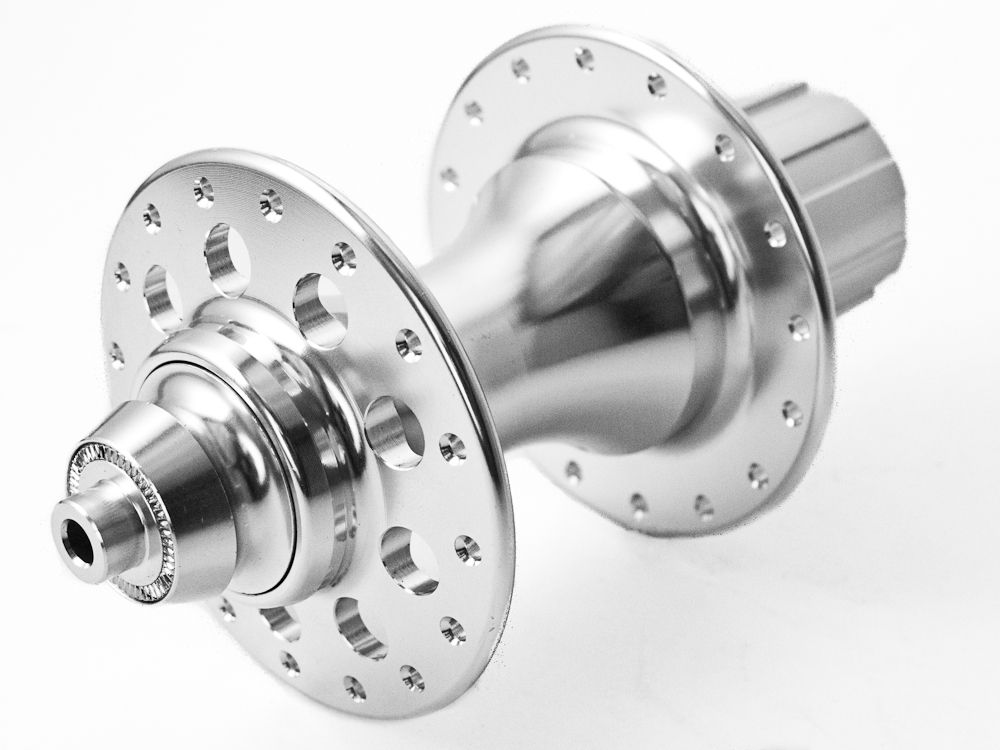
Fixed and High-Low Hubs Arrive


The Grand Cru high flange touring hubs have been delayed by a few days, but will be here soon.
We'll be building wheels based on these hubs and our rims soon. Are there any particular combinations you'd like to see?
24 May, 2011
Quill Stems Arrive
The choices of high quality quill stems has been getting a little thin these past few years. We received three new models today. More choice is good?
The Grand Cru Stem

Quill length is 180mm, or 120mm above the min. insert line. 26.0mm clamp. Alloy wedge. Weight is 385g (for 100mm size)
The VO Chrome Stem

Here is a less expensive chrome stem with positive rise. The VO Quill Stem is a smooth welded chrome plated 1" quill stem. It has a 17-degree positive rise.
Total quill length is 190mm or 120mm above the min. insert line. (Interestingly, it will get your bars as high as a Technomic stem, yet it weighs a little less.) 26mm clamp. Alloy wedge. Weight is 367g for the 100mm size.
The Grand Compe ENE Stem

180mm total height, 115mm above the min. insert line. 26.0mm clamp. Alloy wedge. Weight is 340g for the100mm size.
20 May, 2011
Converting From 26" to 650b
By Nicholas Carman
Less than a week working at VO and I already wanted to taste the 650b nectar. I have been riding larger tires for quite some time, but while touring the tires I ride weigh more than some modern racing frames and I have come to realize that at some point in tire size, bigger is not necessarily better. Having settled into town, I opted for a lighter, faster tire; something that would race around town a bit, then take me out to the country with greater ease and enjoyment. The list is short for quality, medium volume tires that would fit my 1985 Schwinn High Sierra or my girlfriend‘s Surly LHT; both are 26” bikes with drops and touring equipment. I saddled up on a pair of 38mm Panaracer T-Serv tires, and was immediately underwhelmed by the ride of small wheels and smaller tires.
The workshop at VO is full of treasures, and I found a pair of space-age cantilever brakes (the next version of the Grand Cru) that I wanted to test. Upon mounting them, I realized that they had a lot of vertical adjustment…some quick calculations and a few minutes later there was a 650b wheel mounted in my frame with the brakes adjusted at the top of their range. The thought of finally riding high-quality, larger volume tires seemed heaven-sent. Road bikes have many high quality tires to choose from, although they are mostly too narrow for my needs. My mountain bike frame is happy with many tough, long-wearing road touring/commuting tires, but the ride quality of even the best options is a bit uninspired. The magic of 650b, I realized was the option to ride lightweight, high-quality tires with reasonable air volume like the Pacenti Neo-Moto without undersized or oversized wheel dimensions. In short, I didn’t have to choose anymore-- I could ride nice, big tires. I mounted a pair of Pacenti Pari-Moto tires and was immediately hooked. The volume of the tire, the supple casing, and lightweight (less than 300g) made for the most lively ride I’ve ever experienced. With the 650b Pari-Moto, my wheel is the same size as my previous touring wheel, thus, the bike handled in a more familiar way than it did with the undersized Panaracer T-serv tires.

If you wish to ride tires under 32mm, 700c works well as there as more than a few tires to choose from. For tires over 42mm, 26” is a good place to be. But if you want the dreamy, quick and comfortable ride on high quality, larger volume tires between 32-42mm, 650b is where it’s at.

26“ to 650b conversion details: Most classic mountain bikes and some popular modern offerings such as the Surly LHT (26”) have adequate clearance for all of the smooth tread 650b tires. A 650b/38mm wheel actually suits the dimensions of the LHT better than a narrow 26”/32-38mm wheel, which leaves gaping clearances and unfamiliar handling. Conversion simply relies on a brake with 12.5 mm of vertical adjustability (half the 25mm difference between 559 and 584). We have already identified that Tektro CR720 brakes work at the top of their range, as did a prototype Grand Cru brake hanging out in our shop. Of course there are a few v-brake designs that have been around since the 90’s with loads of vertical adjustment as well.
A little about Nicholas,
Since diving into bike touring three years ago, Lael and I have toured around much of the US, including trips on both coasts (three times on the west coast). Three months in France early last spring allowed us ample time to travel the countryside, from our home in St. Malo, Brittany to Chamonix-Mt. Blanc and back, among many shorter regional trips. This past winter we biked south from Seattle and down the Baja Peninsula, then sailed to the mainland and rode into the Sierra Madre to the Copper Canyon. We have lived and worked seasonally in St. Malo, FR, Denali, AK and finally in Key West, FL where we worked as pedicab drivers for several months to escape the northern winter.
19 May, 2011
The 50-Order Club
A short post by Annette:
Back in October 2009, I wrote of a customer who had just gained free shipping forever from Velo Orange:
"Today's feat, however, can't go unacknowledged, as the weird convergence of customer loyalty and warehouse accuracy will likely never be repeated. One of our customers has placed his 50th order. Amazingly, we have never messed up a single order of his..."
One and half years later, a second customer has gained membership in the VO Free Shipping Forever club, despite our messing up at least one of those orders.
Strangely, the relationship between us and the first club member continues to be defined by weird convergence: his latest order was number 100010000.
Thanks to both for sticking with us through thick, thin, and 100010000.
17 May, 2011
How to Disassemble the Grand Cru Touring Hub Without Tools
Kyle shows us how to disassemble the Grand Cru Touring Hub, a VO Cinema Presentation, photographed and directed by Alec Burney.
Grand Cru 4 Bearing Hub from Alec Burney on Vimeo.
16 May, 2011
In Japan


13 May, 2011
Outside Magazine on the Polyvalent


"Easily the most versatile bike out of dozens tested, the chromoly Polyvalent handles like a dream on long city voyages with as much as 40 pounds on the front rack"
Unfortunately we are currently out of the very popular Polyvalents. Our work on the redesigned fork delayed production by almost 4 months and we ran out of frames. I'm pressing the factory for an accurate delivery date and will post it as soon as we know. We are also looking into a pre-ordering system, but I'm not sure this is a good idea since frames seem never to arrive on schedule. We'll offer the mini-build kits again when the new frames arrive, but we are also considering offering full-build kits, maybe even complete bikes.
Here' a summery of the changes for the next batch:
- Larger diameter down tube to make the frame a little stiffer because lots of folks are carrying really big loads on Polyvalents.
- Down tube shifter bosses.
- Nicer fork bend.
- Added low-rider bosses.
- Shiny dark green paint.

10 May, 2011
Interviews
In case you missed the tweet, Thomas Armstrong of the 70.8% blog posted an interview with some guy who's been in the boat and bike biz. 70.8% is actually a great blog that I've been reading for awhile. The interview with Steve Roberts, a couple of posts down is also worth reading. Check out the photo of his bike, named Behemoth.
06 May, 2011
Miscellany

We are starting work on a Mark 3 version of the Grand Cru Canti brakes. They will have an lengthened lever arm for more stopping power. Additionally, there is enough up-and-down pad adjustment to convert 26" mountain and touring bikes to 650b. With them you could use 650b wheels on your LHT or classic Stump Jumper and have access to all those wide soft tires, like the great Pari-Motos, with minimal rolling resistance.
The Mark 3 brakes were not designed with conversions in mind; we simply discovered an added benefit to the longer adjusting slots. I expect that taking an old mountain bike and having the fork re-raked might make an acceptable low-trail 650b touring bike. Re-raking is fast and easy and can be done without damaging the paint. Anyone have more experience with this? BTW, these brakes will be an additional model, not a replacement for the Mark 2.
Speaking of touring bikes, the 700c Polyvalent will officially be in the prototype stage next week. That means that we will be waiting for prototypes instead of just second-guessing all the details we put on paper (actually CAD). The main changes from the 650b Polyvalent are, vertical dropouts, slightly shorter top tube, longer chain stays, 3 sets of bottle cage bosses, and more rack mounts. Now we need to pick a color. Blue-gray? Dark gray? Custard?

We often get asked if the Porteur rack will accept panniers. Yes; the rack works perfectly with most panniers. I like to hook panniers on the inner rails, as in the photo. They can also be attached to the outer rail, but then they lean outward which looks odd to me.
03 May, 2011
Porteur Rack Accessories
Bjorn made a neat adapter to mount a Porteur Rack on his 1948 bicycle. Check out the post about it on his blog, The Accidental Hermit. The rest of his blog is pretty interesting too.

Chris makes slats for VO Porteur racks. They really look nice. He also has a lovely old Atala.
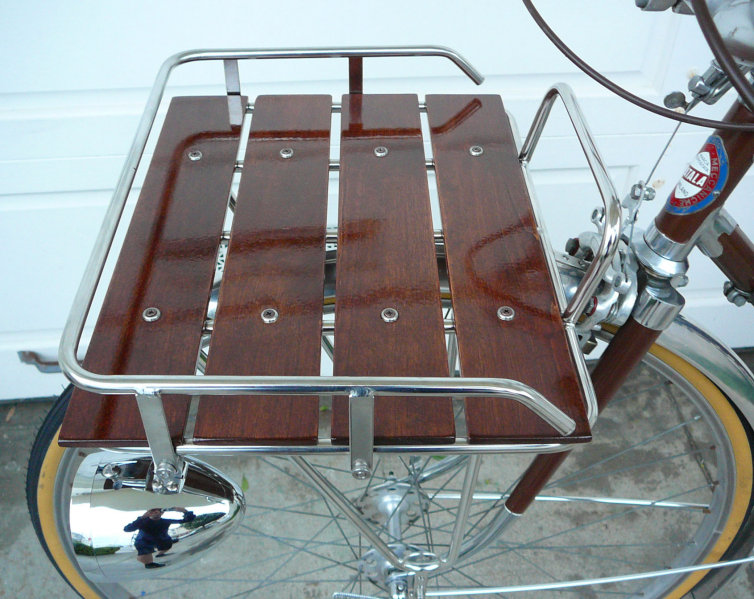
We get a lot of e-mails from folks saying they really like the Porteur Rack, probably more than about any other product. I wonder if we should also make a bigger version?
02 May, 2011
Folding Kayaks

We went kayaking yesterday in our folding kayaks. What does this have to do with bikes? Nothing except that I've notice that people who use, and travel with, folding kayaks are a lot like bike tourists, and many do both. And I though at least a few readers might like to know about them.
We've owned two folding kayaks for about 15 years. And in that time we've used them in British Colombia, the San Juan Islands, Lake Powell, along the Maine coast, in Nova Scotia, in the Florida Everglades, and in dozens of other lovely spots. Some times we camp, carrying all our gear. Other times we stay at inns and take day trips. And because the kayaks fold into a few neat canvas bags, we check them as airline baggage and transport them in a rental car. Once on the beach the wooden frame and canvas/hypalon skin can be assembled in about 15 minutes.
Sea kayak touring has a lot in common with bike touring. You move along at a moderate pace with minimal of effort and enjoy the scenery. You can carry more than you would on a bike. And, so long as you are careful of weather and surf landings (avoid them) it's very safe.

The brand of kayaks I like are Kleppers, which are made in Germany and known for their ruggedness and quality. They are the choice of many expeditions to remote regions. At least one has sailed across the Atlantic; yes, they can be rigged with small sails. They are also used by many military "commando teams", assembled on the deck of a submarine and paddled in under cover of darkness. There are several other good brands that are less expensive, lighter, and maybe a better choice for casual use. I've used and liked Feathercraft, Folboat, and Pouch folding kayaks. The French Nautiraid kayaks also have an excellent reputation.

Sadly, Sunday was probably our last paddle in the Kleppers. Our son wants a sit-on-top kayak for fishing and snorkeling and one that's small enough that he can wheel it down to the launch point a few blocks from our house (using a kayak cart). And with VO taking so much time we don't use the Kleppers often. So we decided to sell them and get smaller roto-molded plastic boats. When he is older I hope he wants a folder.
Next post will be about bike stuff. But meanwhile do any readers sea kayak?
29 April, 2011
The No-Rivet Leather Saddle


I'm putting this prototype on my bike to see how well it works and lasts. It would be more expensive to make saddles this way, mostly from welding threaded bosses to the frame to accept the screws. And they are a little heavier. On the other hand, the top could be easily replaced and there are no rivets that stick up. If we made a titanium-framed version it might be truly great, and truly expensive. Wadda you think?
28 April, 2011
On Fenders and Perceived Quality and the Blog
Regarding fender installation, we still get a lot of questions about this and will soon have a video that should help. One of the most common errors in assembly that we see is folks putting the cup shaped washer on the eyelet draw bolt upside down, which allows the fender to rattle. This applies to Honjo and to VO fenders. Here is a photo of how everything fits together; notice that the bolt-head with the hole fits inside the cup:

As we get new production runs of fenders we are switching to two eyelet bolts per stay (except on the narrowest models since they won't fit). This is being done for a rather odd reason. Honjo fenders use two eyelets because they occasionally crack at the eyelet with only one. VO fenders have never had this problem, but so many customers equate two eyelets with better quality that we are adding a second. For what it's worth, if a fender cracks it's almost always at the seat stay or at the fork crown and usually because there is some built in tension.
This reminds me of those little diamond-shaped reinforcements plates you see at the seat stay bridge on some bikes. No one here has ever seen a seat stay bridge fail on a well-built frame, except for one that had those little plates (the brazer probably cooked the joint). Maybe they were needed for some super thin tubing or some frame builders added them for looks. Now many cyclist seem to think they are a hallmark of a quality frame. Perceived quality.
On another subject, The comments on the VO blog are surprisingly civil, at least compared to a few other blogs I read. We do very occasionally reject comments for the following reasons:
- Obvious spam or less obvious spam, like linking to another store or blog without it adding value to the conversation.
- General rude tone in a comment.
- Repeating an answer or explanation that has already been posted in another comment. It's simply polite to read the existing comments before posting so future readers won't have to read the same thing over-and-over.
- Containing information or advice that I know to be totally wrong or dangerous, doesn't happen often.
25 April, 2011
Forks and Shirts

We also have some new Grand Cru t-shirts. They are made from organic cotton. I'm a big advocate of organic cotton. Did you know that non-organic cotton uses approximately 25% of the world's insecticides and more than 10% of the pesticides (including herbicides, insecticides, and defoliants)?
BTW, check out the outtakes from the t-shirt photo shoot.

22 April, 2011
A Few Updates
Here are a few updates on projects. We've received a bunch of e-mails asking about these.
Camping Racks- After much testing, fitting, measuring, and pondering the first prototypes, we sent off revised drawing for the camping racks. We hope to have second generation prototypes in about 6 weeks. I really want to get these right and am not pushing to have them done quickly. So there is no ETA; we'll do another round or two of prototypes if needed.
The new Polyvalent 650b- The final (I hope) upgraded fork is complete and should arrive here next week. If it is right we'll schedule production. The factory says they can complete the frames in about 3 months (add another for shipping) but there are always delays, always.
VO and Grand Cru cassette hubs- The high-low VO hubs are steaming toward us even as I write this, so late May. The high flange Grand Cru Touring hubs should be air-freighted around mid-May. We'll offer some on the site and have some built up into wheels.
The Freewheel- After about 1500 miles of testing the first one started making a clicking noise. We took it apart to find lot of wear, grit inside, and a bad ball bearing. If this is the best freewheel made in Taiwan, as I was told, then we're very disappointed. It's no better than any of the current offering. To make it right it would need proper seals, better bearings, larger pawls, etc. On the bright side, the cogs still looked great. Next time I'm in Taiwan I'll see how much it would cost to make the needed improvements, but I'm pretty sure that the tooling costs will be prohibitive.
Below is our new magazine ad. I guess we're finally going to start paying more attention to print advertising, something we've neglected up to now.

20 April, 2011
Slow Sellers
Lots of VO components and accessories sell well beyond our expectations, but I thought I'd write about a few that don't. I really like these and don't understand why they are not more popular. Maybe if I explain why I like them?


Finally, we put our sprung saddles, the Model 5 and Model 8, on sale. These are great saddles not only on city bikes, but also on touring bikes. They really help smooth out potholed roads. The only downside is the added weight of the springs and frame, a small price to pay for comfort if you're not in a hurry.
What's your favorite non-mainstream bike bit?
15 April, 2011
On Randonneuring
A guest post by Alec Burney

Spring has finally come to the Mid Atlantic, and Spring for us means that the local cycling clubs are getting into the real swing of things once again. There are clubs out there for all kinds of riders, but randonneuring groups hold a special place in our hearts here at Velo Orange.
Randonneuring is centered around endurance cycling - riding comparatively long distances. The events are timed, and in order to qualify, a rider has to prove that they completed the ride (brevet) within the time allotted. Riders are seriously interested in qualifying, because the rides are preliminaries to a Grand Randonée, and this year Paris-Brest-Paris overshadows all others. Americans seeking to participate in a 1200k ride like PBP will need to complete a 200k, 300k, 400k, and 600k brevet within the time limits.
These rides are the original form of “credit-card” touring. Riders pack light to travel as easily and quickly as they can, allowing them to see far away places with relative ease, and requiring that they stop periodically to sample local food and spend the night at an inn.
Like most randonneuring clubs, our local group, the DC Randonneurs, is a cycling club that emphasizes the social aspect of group riding. Even though events are timed, the reason people keep coming back is to see their buddies, sit down and chat over a mid-ride lunch, and laugh about the last time someone took a nap in a ditch.
Even though many folks in the club try to push themselves to faster times and farther distances, the rides that enjoy the heaviest attendance are those with the best scenery. The sport for many is more like bike touring than it is like a stage race. Camaraderie, exploration, and the experience of a day spent riding are the dominant priorities and no one feels the need to ride harder than they want to, or to “beat” anyone else. There’s no “A” group or “B” group, only various social groups. Civility is absolutely required, collaboration is encouraged, and everyone is looking for a pleasant day.

Our next ride will be the 24-hour Flèche; though the rules are very complicated, the spirit of the event is rooted in camaraderie. The Flèche is a very social team ride, with a common goal - to get every member of the team to the finish, together. Teams will start in different locations, design their own routes, and on Saturday morning they’ll head towards Washington DC to meet over breakfast at the finish. Most teams select easy routes and take advantage of the 24 hours as social time to chat, get to know one another, and celebrate the shared challenge. It’s also a good time to sample restaurants, with plenty of time to sit and eat. Each team will see the sunrise and sunset before their ride is over, and the time in between the start and finish will prove to be a memorable one for all.
In case you're interested, here is the link to RUSA (Randonneurs USA) which has more information and links to local groups around the country.
In case you're interested, here is the link to RUSA (Randonneurs USA) which has more information and links to local groups around the country.
08 April, 2011
Freewheel Testing and Last Mixte

You can give us a little help by telling us how long various freewheels you've used have lasted. And do you have thoughts about how/why they failed.
Also, we find that we have one 54cm VO Mixte frame left. It was used as a display and has a headset and BB installed, but is unridden. Update: it's sold.
05 April, 2011
Nuts!


They are finally here and look really cool on our new track hub prototypes. They are forged from stainless steel, then CNC finished and polished. And check out the alloy keyed washers.
But the factory neglected to chase the threads so they don't spin on as smoothly as they should. Our staff has been opening the packages and chasing the threads by hand, but we can't do them all, too time consuming, and will send most back. We are only selling the ones that have been chased.
It really bugs me when this sort of thing happens. I suppose it's inevitable since VO introduces more new products than most companies five times our size. And new products inevitably have problems (just ask Apple). Still, it's not like we rushed these to market; the prototypes were absolutely 100% perfect. Nuts!
UPDATE: The factory has rethreaded all the wing nuts we sent back and air-freighted them back to us. We have wing nuts again and they work as they should.
01 April, 2011
Polyvalent 700
These past few days we've been tweaking the plans for the 700c version of the Polyvalent that we hope to introduce next year. A second prototype should be in the works soon with some small improvements and one rather major change.
First the easy stuff, this new frame has geometry that's a bit more touring oriented than the 650b version. That means slightly longer chain stays, a slightly shorter top tube, and full rack braze-ons front and rear. It will also probably have vertical drop-outs We are still discussing the final geometry and little details such as behind-the-seat-tube pump pegs and a kickstand plate.
The bigger change is one I've wanted to experiment with for many years. As you know, our designs are inspired by the French constructeur bikes, which I believe were the pinnacle of classic bicycle design. What you may not know is that there were several great constructeurs who worked not in steel but in Dural (or aluminum alloy). Perhaps the most famous of these was Pierre Caminade, who created fantastic touring, rando, and city bikes from lugged aluminum tubing. His bikes have a reputation for a silky smooth ride. Joel Metz's Blackbird site has a great section on Caminade's bikes and components.


31 March, 2011
A Few New Items
We received a few new items in the latest container: Here are some of them:


And we have a silver polished version of our Temple Bell. It's still made of brass so the sound is really nice.
25 March, 2011
Report From the Beautiful Island

We visited several factories that make our parts and met with many more suppliers at the Taipei Cycle Show. The longest meeting was with our rack manufacturer where we went over the myriad details required to make our new touring racks. I don't think these will be ready before fall. There is really a lot involved in getting them just right. We're also working on a new saddle bag support.
At our handlebar factory we approved the prototype stainless steel VO 25.4mm-26.0mm shims. These will be priced lower price than the only existing type and we'll have a wider version for use with threadless stems. We also discussed our new short reach drop bar and arranged to have all the logos on our city bars changed from laser etching to the engraved or stamped version.
Dia Compe has some new Campy-look shifters that we'll be stocking in down tube and bar end versions. There are a few other surprises from the folks at DC, including a new version of their touring frame that looks very nice.

Our brake manufacturer showed us some prototype cantilevers reputed to be more powerful than existing models. We'll be testing them soon and may develop a Grand Cru version.

Many of you had asked us to look for a high-end frame pump. I'm afraid that I found nothing that I thought was particularly better than models already on the market. We talked about opening tooling for a Grand Cru pump, but I doubt that sales could cover the costs. The simple fact is that mini-pumps and mini-floor pumps are now so good that most cyclists, myself included, don't bother with a frame pump. The only advantage of a frame pump is inflation speed, and I'm not in that much of a hurry.
We also scoured the show for retro-style lights. There is only one possibility so far and it would be expensive, but we'll explore it further. With so much going on I'm unwilling and unable to devote the time it would take to develop our own lights from scratch. We can't make everything and keep what little sanity remains.
One project that's been behind is the next production run of the Polyvalent frames. We're making a few small refinements including improving the bend of the fork blade; that's caused the holdup. With luck we'll have the final version of the new fork in two weeks and production can proceed. We're also working on a 700c version of the Polyvalent that will be more of a touring bike.
There's a lot more, but those are the highlights. I'll leave you to ponder, and comment on, the following photos.


Subscribe to:
Posts (Atom)

 Posts

